


A bicycle ride can change in seconds when a vehicle suddenly turns right across a cyclist’s path. This type of collision is often called a right-hook accident. It commonly happens when a driver traveling in the same direction as a cyclist turns right at an intersection, driveway, or other access point without properly accounting for the bicyclist.
For cyclists, the consequences can be serious. According to the National Highway Traffic Safety Administration (NHTSA), 1,103 bicyclists were killed in traffic crashes in 2024. NHTSA also notes that bicyclists are particularly vulnerable to injury when involved in crashes with motor vehicles.
Understanding how right-hook crashes happen and what to do afterward can help injured cyclists protect their health and legal rights.
What Is a Right-Hook Bicycle Accident?
A right-hook accident occurs when a motorist turns right across the path of a bicyclist traveling in the same direction.
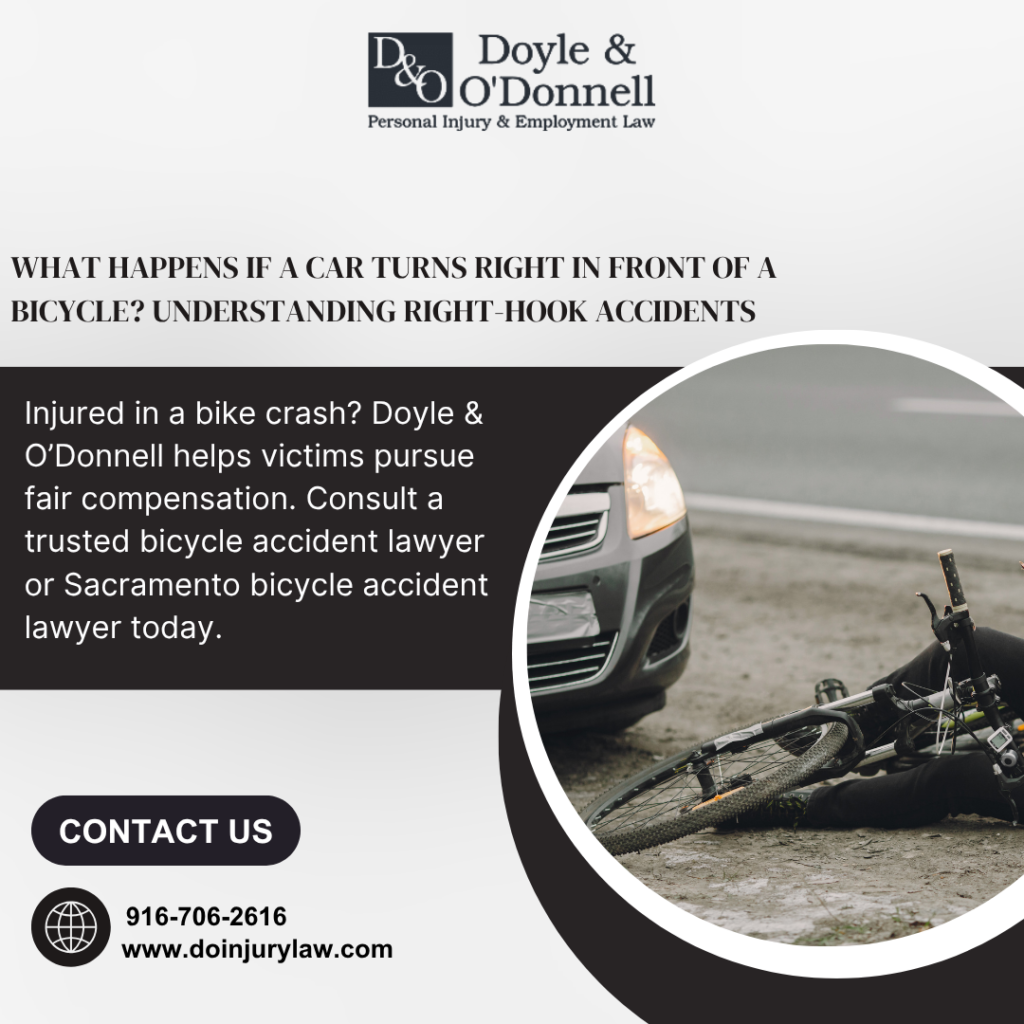
For example, imagine a cyclist traveling through a Sacramento bike lane. A car approaches from behind, moves toward the intersection, and suddenly turns right across the cyclist’s path. If the driver does not see the cyclist or fails to yield, the cyclist may crash directly into the vehicle or be knocked to the pavement.
These collisions can happen because of:
- Driver distraction or inattention
- Failure to check mirrors or blind spots
- Failure to use a turn signal
- Improper merging into a bike lane
- Misjudging a cyclist’s speed
- Attempting to turn before a cyclist reaches the intersection
California Law and Right Turns Across Bike Lanes
California law gives bicyclists many of the same rights and responsibilities as drivers. California Vehicle Code §21200 states that people riding bicycles on highways generally have the same rights and are subject to the same applicable traffic rules as vehicle drivers.
California also specifically addresses vehicles crossing bicycle lanes to make turns. Under Vehicle Code §21717, when a motorist needs to cross an adjacent bicycle lane to make a turn, the driver must enter the bicycle lane before making the turn and then make the turn in accordance with the applicable turning rules.
California Vehicle Code §22100 further requires right turns to be approached and made as close as practicable to the right-hand curb or edge of the roadway.
This means a driver generally cannot simply remain in the through lane and cut across a cyclist at the last second. The exact circumstances matter, however, including traffic signals, lane markings, the cyclist’s position, and what each person was doing immediately before the collision.
Who Is Usually at Fault in a Right-Hook Accident?
Determining fault requires looking at the complete sequence of events rather than automatically blaming either the driver or cyclist.
A driver may be responsible when they:
- Turn without checking for an approaching cyclist
- Fail to yield when required
- Enter or cross a bike lane unsafely
- Make an unsafe or sudden turn
- Drive while distracted
- Violate traffic laws
However, insurance companies may investigate whether the cyclist also contributed to the collision. California law requires cyclists to follow applicable traffic rules, and Vehicle Code §21202 establishes circumstances governing where a cyclist should ride on the roadway.
Because fault can involve disputed facts, evidence can be especially important in a bicycle accident claim.
What Should You Do After a Right-Hook Crash?
If you are physically able to do so after a collision, consider taking these steps:
- Get medical attention. Some injuries may not become obvious immediately after a crash.
- Call the police. An official collision report can provide important documentation.
- Take photographs. Photograph your bicycle, the vehicle, road markings, traffic signs, damage, and the surrounding area.
- Collect driver information. Obtain the driver’s name, contact information, insurance details, and vehicle information.
- Look for witnesses. Independent witnesses may help establish how the collision occurred.
- Preserve evidence. Keep your damaged bicycle, helmet, clothing, photographs, medical records, and repair estimates.
- Avoid admitting fault. Stick to the facts when speaking with the driver, police, or insurance company.
If the driver leaves the scene, try to record the vehicle description, license plate number, direction of travel, and any available witness information without putting yourself in further danger.
What Compensation May Be Available?
A successful bicycle accident claim may potentially involve compensation for losses such as:
- Emergency and ongoing medical expenses
- Physical therapy and rehabilitation
- Lost wages or reduced earning capacity
- Bicycle and other personal property damage
- Physical pain and suffering
- Emotional distress
The value of a claim depends on the severity of the injuries, available evidence, insurance coverage, financial losses, and other circumstances.
A bicycle accident lawyer can review the available evidence and help determine what damages may be appropriate to pursue.
Why Evidence Matters in Bicycle Accident Claims
Right-hook crashes can become a dispute over what each person saw and did. A driver might claim the cyclist appeared suddenly, while the cyclist may remember the vehicle turning directly across the bike lane.
Evidence can help clarify the situation.
Useful evidence may include:
- Traffic-camera or nearby business surveillance footage
- Bicycle or helmet camera recordings
- Dashcam footage
- Photographs of the crash location
- Police reports
- Witness statements
- Medical records
- Vehicle damage
- Bicycle damage
- Cellphone or other relevant records, when legally obtainable
The sooner potentially useful evidence is identified and preserved, the better.
How Long Do You Have to Take Legal Action?
California generally provides two years to bring a personal injury lawsuit based on another person’s wrongful act or neglect under Code of Civil Procedure §335.1.
However, this does not mean an injured cyclist should wait two years before seeking legal advice. Evidence can disappear, witnesses may become difficult to locate, and insurance companies may begin evaluating a claim soon after the accident. Different deadlines can also apply in certain circumstances, so speaking with a qualified attorney promptly is important.
When Should You Speak With a Bicycle Accident Lawyer?
You may want to consult a bicycle accident lawyer if you suffered significant injuries, the driver disputes responsibility, the insurance company is denying or minimizing your claim, or your medical expenses and lost income are substantial.
An attorney can investigate the crash, review available evidence, communicate with insurers, evaluate potential damages, and explain your legal options.
Get Help After a Sacramento Bicycle Accident
A right-hook collision can leave a cyclist dealing with painful injuries, expensive medical treatment, damaged property, and uncertainty about what to do next. Doyle & O’Donnell helps individuals understand their options following bicycle and other vehicle-related accidents. If you were injured when a vehicle turned across your path, a Sacramento bicycle accident lawyer from Doyle & O’Donnell can review the circumstances of your accident and help you understand the potential legal remedies available to you.
#BicycleAccident #SacramentoBicycleAccident #BikeSafety #PersonalInjury #SacramentoLawyer #CyclingSafety